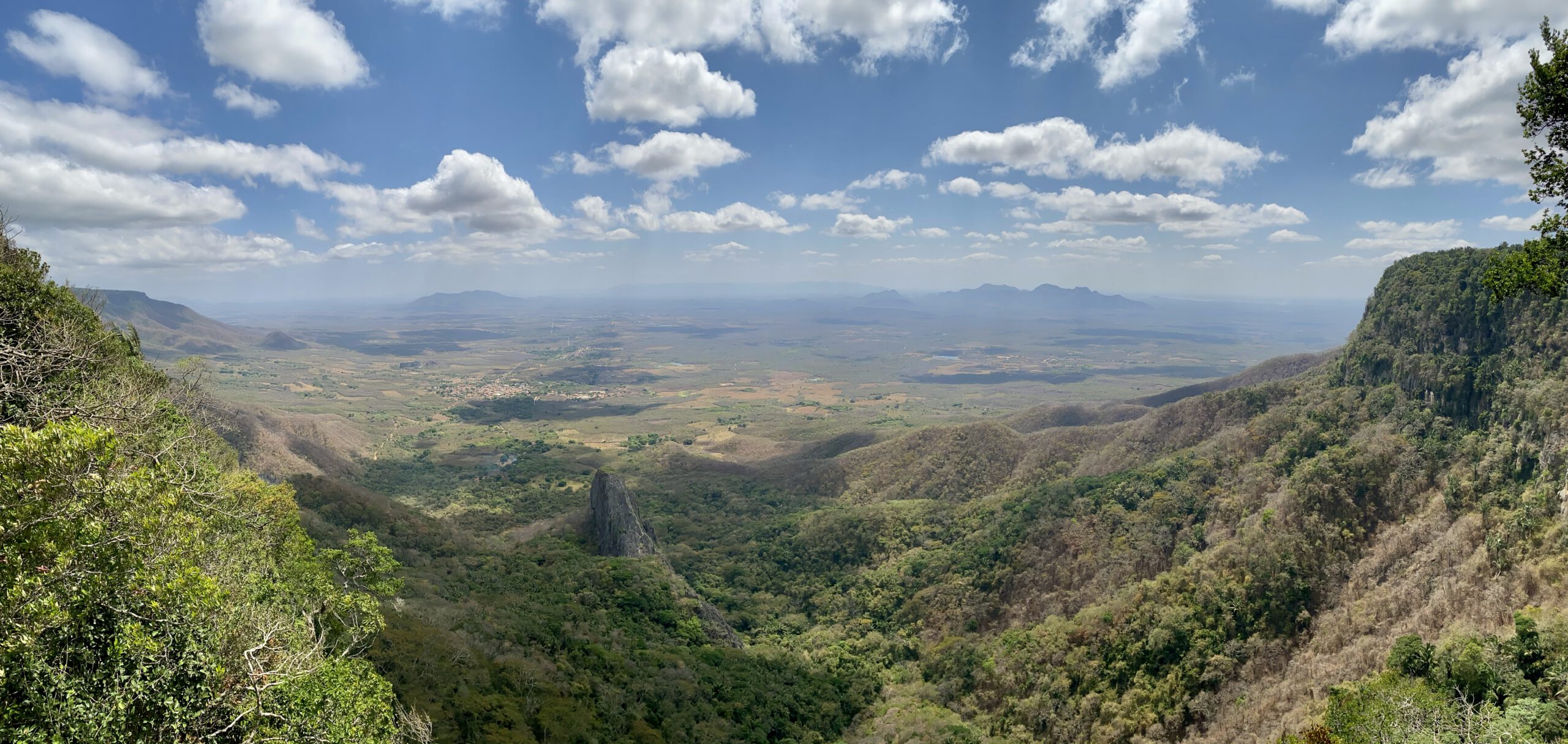
Ubajara National Park (UNP) is located in the Ceará State, northeast of Brazil. It is known by the Ubajara Grotto, a beautiful limestone cave accessed by a chairlift, and by its trails and waterfalls. The park is one of the few preserved areas within the Caatinga biome, a Brazilian dry-thornbush savannah. However, this is a much more humid Caatinga area compared to Serra da Capivara National Park.

The bearded capuchin monkey (Sapajus libidinosus) is one of the primate species that inhabit the park, along with the endangered Caatinga howler monkey (Alouatta ululata) and the common marmoset (Callithrix jacchus).
In 2020, our researcher Tiago Falótico and the CapCult team began to study this population for the first time, mapping the nut-cracking sites. We discovered that they use stone tools to crack open mainly babaçu nuts (Attalea speciosa) and macaúba nuts (Acrocomia aculeata). These food resources are really hard: the force to crack a macaúba nut is twice as much as to crack a macadamia and the force to crack a babaçu is eight times higher!

One of the most interesting aspects of this park is the presence of two different ecosystems side-by-side. The highland has Tropical Seasonal Evergreen vegetation, lower temperatures, and higher rainfall. The lowland has Stepic Savannah vegetation, higher temperatures and lower rainfall. These ecological differences reflect on the availability of palm nut trees, stones, and consequently capuchin monkey’s behaviors. Nut-cracking sites are more abundant in the lowland in comparison to the highland.
In 2021, a group of this population was followed for the first time by our researcher Tatiane Valença during her PhD studies at the University of São Paulo. During the habituation of the Sertão Group, she noticed that the alpha female, named Baleia, had an infant with a leg disability. The mother and other group members took special care of Balaio, the infant, who had difficulties to properly cling to the mother. Unfortunately, Balaio died some weeks later and the mother continued to carry and groom the corpse for a while. In 2023 she had another infant, Beiju, who is developing well.

From 2022 to 2023, tool use, terrestriality, and other ecological factors were systematically recorded by Valença with the assistance of our members, Gabriela Affonço and Guilherme Mugnaini, and also our collaborators, Emiliane Cardoso and Germando Cardoso. In her PhD studies, she is describing the tool use repertoire of this population. She is also investigating whether terrestriality may affect the areas where the monkeys use stone tools and why bearded capuchin monkeys are so terrestrial. This data is currently being analyzed with the assistance of collaborators in the Max Planck Institute of Animal Behavior in Germany.

In 2022, the CapCult team also began to conduct primate archaeological studies of Primate Archaeology in this population. Our researcher, Gabriela Affonço, is currently in her master’s studies at the University of São Paulo, studying the fragments and flakes generated by the capuchin’s nut-cracking activities.
References:
- ICMBio
- Valença, T., Cardoso, E., & Falótico, T. (2025). Predatory attack on a bearded capuchin monkey by a Boa constrictor. Primates, 66(4), 349–353. https://doi.org/10.1007/s10329-025-01191-7
- Falótico, T., Valença, T., Verderane, M. P., Santana, B. C., & Sirianni, G. (2024). Mapping nut‐cracking in a new population of wild capuchin monkeys (Sapajus libidinosus) at Ubajara National Park, Brazil. American Journal of Primatology, 86(4), e23595. https://doi.org/10.1002/ajp.23595
- Valença, T., & Falótico, T. (2023). Life and death of a disabled wild capuchin monkey infant. Primates, 64, 207–213. https://doi.org/10.1007/s10329-023-01052-1